Burdock: Exploring the Benefits of Roots, Leaves, Stalks, and Stems
Do you ever see people picking plants in parks or on sidewalks? They’re foraging!
Foraging is the practice of exploring an area to pick wild plants, often for food or medicine, but also for craft and other raw materials. It’s an important practice in many cultures, especially in many of the communities which live around Tacony Creek Park. We often see neighbors foraging in the park!



Foraging is also a fun hobby that many people picked up during Covid. It may be intimidating to start foraging if you aren’t sure what you’re looking for. That’s why we introducing a series of edible plant guides, written by our Alliance for Watershed Education
This is the third of our Edible Plant Guide series which will feature these commonly-seen plants:
- Broadleaf Plantain | Llenten
- Common Mugwort
- Greater Burdock
- Black Walnut
- Yellow Wood Sorrel
Greater Burdock (Arctium lappa)
Greater Burdock is a biennial herbaceous plant that prefers disturbed soil in meadows and fields. It is native to Europe and East Asia. It has been naturalized throughout North America.
Identification and Look-alikes
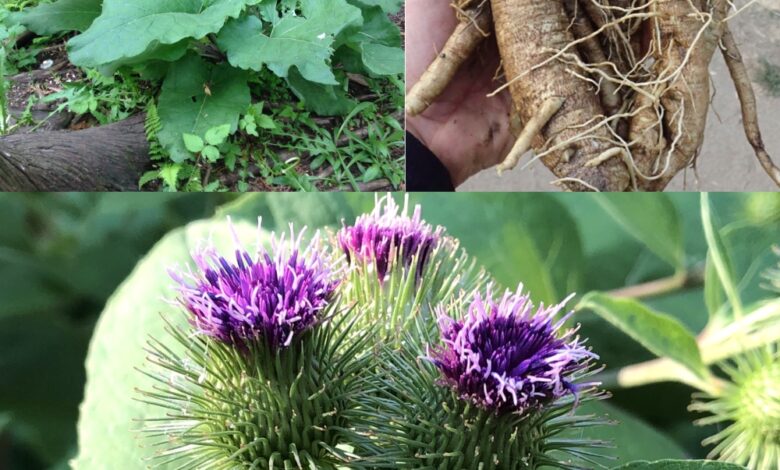
Greater Burdock has large, heart-shaped leaves that are fuzzy underneath. In its second year, purple florets surrounded with hooked bracts appear. Burdock is a thistle and is often confused with Bull (Cirsium vulgare) and Milk (Silybum marianum) thistle. The easiest way to tell if the plant you found is burdock is if the stem and leaves do not have spines. Another look-alike to Greater Burdock is Lesser Burdock (Arctium minus). Greater Burdock, unlike Lesser Burdock, is taller, and its flowers have a longer stem than Lesser burdock. Both burdocks are edible and share uses.
Is it Edible?
The root, stalks, and leaves are edible. Young roots can be eaten but must be cooked as it matures. They are often pickled, braised, or dried. When dried, they make a lovely tea. The leaves can be used in a salad when it’s young. Burdock’s flowering stalks are peeled and
cooked as a vegetable. The leaves and stems have a bitter taste, while the root has an earthy and nutty flavor, similar to parsnip.